Why I am writing this
In my previous blog, I wrote about whether it is still worth being a software engineer when AI can write code.
One important idea deserves its own discussion:
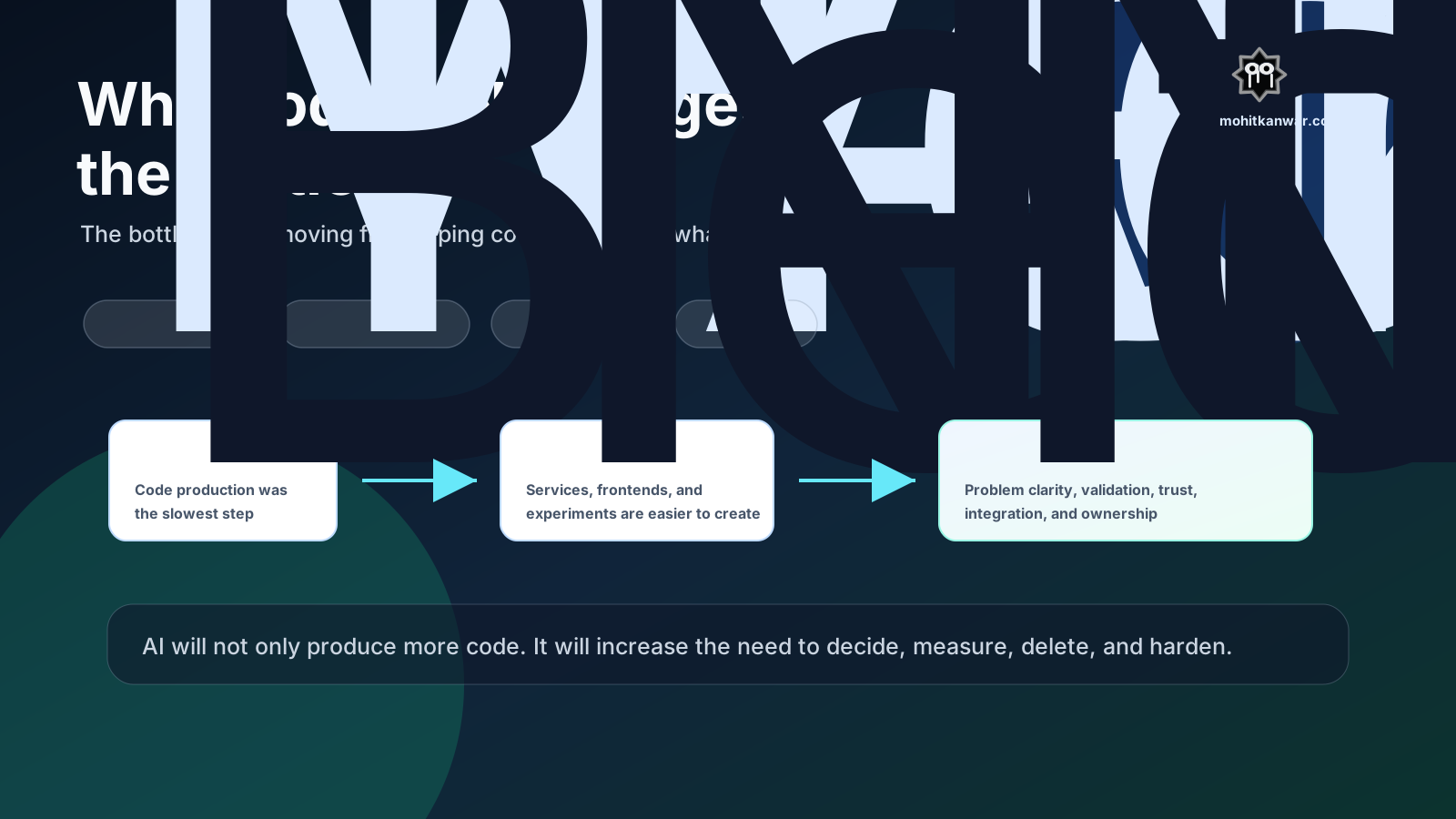
Code is no longer the biggest bottleneck.
This may sound strange because engineers still spend a lot of time writing, reading, reviewing, and debugging code.
But the direction is clear.
Code is becoming easier to produce.
The bigger bottleneck is deciding what should be built, whether it solves a real problem, whether users actually need it, and whether the organization can support it responsibly.
We were already moving in this direction
AI did not start this shift.
We were already moving toward smaller, more replaceable, more disposable pieces of software.
Microservices changed the way we thought about backend systems.
Microfrontends changed the way we thought about frontend ownership.
Feature flags changed the way we released functionality.
Cloud platforms and CI/CD changed the speed at which we could deploy.
Instead of treating every application as a large permanent structure, teams started building smaller pieces that could be changed, replaced, scaled, or retired independently.
That changed the mindset.
Earlier, the question was often:
“How do we build the right thing once?”
Now the question is more often:
“How do we learn quickly what the right thing is?”
That is a very different engineering problem.
Microservices made code more disposable
Microservices were not only about scaling services independently.
They also made it easier to isolate change.
A team could build a new service, test a capability, learn from production usage, and later replace it without rewriting the entire system.
Of course, this worked only when the boundaries were good.
Bad microservices created distributed confusion. Good microservices created independent learning loops.
That is the real point.
If the boundary is well designed, the code inside that boundary becomes more replaceable.
The contract matters more than the first implementation.
For example, if a payment investigation capability is exposed through a stable API, the internal implementation can evolve:
- First version with simple rules.
- Second version with better data enrichment.
- Third version with workflow integration.
- Fourth version with AI-assisted investigation.
- Fifth version with automated recommendations.
The capability continues to improve, but consumers do not need to change every time.
That is how architecture makes experimentation safer.
Microfrontends did the same on the user side
Microfrontends brought a similar idea to user experience.
Instead of waiting for one large frontend release, teams could own smaller slices of the experience.
This made it easier to test:
- A new onboarding flow.
- A new product recommendation panel.
- A new servicing widget.
- A new dashboard experience.
- A new internal operations screen.
The first version did not need to be perfect.
It needed to be safe enough to test and easy enough to replace.
That changed the value of code.
The code was still important, but the learning was more important.
If users did not adopt the new journey, the team could remove it, rewrite it, or try something else.
This is what I mean by disposable code.
Not careless code.
Disposable code means code that is intentionally scoped, bounded, measured, and replaceable.
AI will accelerate this
AI-generated code will make this movement faster.
If it takes weeks to create the first version of an experiment, teams become conservative. They debate more. They delay decisions. They try to predict everything upfront because the cost of being wrong is high.
If it takes days or hours to create a safe first version, the team can learn earlier.
That changes behavior.
Teams can test more ideas:
- Two onboarding flows instead of one.
- Three internal workflow options instead of one.
- A new API wrapper before committing to a full platform change.
- A small automation script before building a full product.
- A prototype agent before turning it into a production capability.
This is where AI is powerful.
Not because it removes engineering.
Because it lowers the cost of the first attempt.

But faster code can create faster waste
There is a danger here.
If code becomes easy to generate, teams may generate too much of it.
More services.
More screens.
More integrations.
More scripts.
More prototypes that quietly become production.
More code that nobody owns after the excitement is over.
This is how faster delivery becomes faster technical debt.
The problem is not speed.
The problem is speed without classification.
Before building, we should know what we are building:
| Type | Purpose | Engineering expectation |
|---|---|---|
| Experiment | Learn whether an idea has value | Small scope, limited users, clear expiry |
| Product feature | Serve real users repeatedly | Tests, monitoring, ownership, support |
| Platform capability | Be reused by many teams | Strong contracts, governance, documentation, SLAs |
| Disposable automation | Remove repeated internal work | Simple ownership, clear failure mode, easy replacement |
This classification matters more as AI accelerates code creation.
Without it, everything looks like a product, but nothing is operated like one.
The bottleneck moves to learning
When code was expensive, teams often spent a long time trying to decide the right answer upfront.
That made sense in a world where the first implementation was costly.
But if code becomes cheaper, the better strategy is often to learn faster.
The bottleneck becomes:
- Can we identify the right problem?
- Can we create a small safe experiment?
- Can we measure whether it works?
- Can we decide quickly whether to continue, change, or stop?
- Can we turn successful experiments into reliable products?
This is a different kind of engineering maturity.
It is not only about writing clean code.
It is about building learning loops.
What architects should do differently
Architects need to design for experimentation.
That means creating boundaries where teams can move quickly without damaging the rest of the system.
Some practical patterns help:
- Stable API contracts.
- Feature flags.
- Canary releases.
- Observability from the first version.
- Clear ownership metadata.
- Temporary environments.
- Thin integration wrappers.
- Event-driven boundaries where useful.
- Reusable authentication and authorization patterns.
- A documented path from experiment to production.
This last point is important.
Most organizations do not fail because they cannot build prototypes.
They fail because prototypes become permanent without going through production hardening.
An experiment should have an expiry date.
A product should have an owner.
A platform capability should have a contract.
What developers should do differently
Developers also need to change how they think about code.
Do not only ask:
“Can I implement this?”
Ask:
- Is this an experiment or a long-term capability?
- What is the smallest useful version?
- What should be measured?
- What will make us stop this experiment?
- What would need to change before this becomes production?
- Which parts can AI generate safely?
- Which parts need human design and review?
This is where the developer becomes more valuable, not less.
AI may write the first version faster.
But the developer decides whether that version is good enough to test, safe enough to expose, and worth evolving.
What business teams should expect
Business teams should also adjust expectations.
If code gets cheaper, it does not mean every idea should become a permanent product.
It means more ideas can be tested.
That is a big difference.
The right conversation becomes:
- What assumption are we testing?
- Which users should see it first?
- What result would prove value?
- What result would make us stop?
- What risk are we willing to take for this experiment?
This creates a healthier relationship between business and technology.
Technology stops being only a delivery engine.
It becomes a learning engine.
The new bottlenecks
If code is no longer the bottleneck, what is?
I see five new bottlenecks.
1. Problem clarity
Many teams can build quickly.
Fewer teams can define the right problem clearly.
2. Decision speed
Fast experimentation is useless if decisions are still slow.
If a team learns that an experiment failed, the organization should be able to stop it without drama.
3. Trust
AI-generated code needs review, tests, security checks, architecture checks, and ownership.
The bottleneck shifts from creation to verification.
4. Integration
Most meaningful business problems touch existing systems.
The first screen or service may be easy. The integration with legacy systems, data, identity, audit, and operations is where the real work begins.
5. Ownership
Someone must own what survives.
Disposable code is healthy only when unsuccessful code is removed and successful code is made reliable.
My view
Code is still important.
Bad code can still hurt the business.
But code is no longer the main constraint in the way it used to be.
Microservices and microfrontends already moved us toward smaller, replaceable, independently tested pieces of software.
AI will accelerate that direction.
This should not scare us.
It should make us more disciplined.
The best teams will not be the ones that generate the most code.
They will be the ones that learn fastest, delete weak ideas quickly, turn useful experiments into reliable products, and keep clear ownership of what remains.
That is the real shift.
The value is moving from writing code to deciding which code deserves to exist.
Related Reading
- Is It Still Worth Being a Software Engineer? - why AI changes the value of engineering work
- Production AI Architecture Is Messy. Here Is How I Would Untangle It - why production AI needs boundaries, ownership, and proof
- APIs Are Forever - why stable contracts matter when internal implementations keep changing
- Authenticating Services in a Microservices Environment - how service boundaries need security and trust
Want to apply these ideas in your organization?
I help fintech and banking teams turn architecture insights into practical execution plans.