
Executive Summary
This is an anonymized case study from a digital banking modernization programme. Names, internal identifiers, and sensitive client details have been removed, but the architecture problems and delivery patterns are real.
The institution had a channel banking landscape spread across mobile banking, internet banking, business banking, APIs, admin tools, reporting, and multiple backend systems. The platform was running important customer journeys, so modernization could not be treated as a clean-room rewrite. The work had to improve the architecture while protecting business continuity.
The central challenge was simple to describe but hard to execute:
How do you modernize customer-facing banking channels without disturbing live banking operations?
The answer was not one technology choice. It required a target architecture, a phased migration path, strong engineering guardrails, disciplined release governance, and a leadership model that could keep product, engineering, operations, security, and business teams aligned.
Situation
The bank had already invested in digital channels, but the platform had grown through multiple delivery waves. Each wave solved a business need, but over time the architecture started showing pressure.
Common symptoms were visible across the platform:
- Similar journeys behaved differently across mobile, web, business banking, and admin tools.
- Multiple teams implemented the same integration logic in slightly different ways.
- Backend systems exposed inconsistent contracts, so channels had to carry too much orchestration responsibility.
- Release planning required heavy coordination because changes crossed many systems.
- Support teams needed better traceability when customer journeys failed.
- Architecture decisions were sometimes documented after implementation instead of before implementation.
None of these problems were unusual. This is what happens when a platform succeeds, keeps adding scope, and does not get enough time to simplify.
Business Drivers
The modernization was not an engineering exercise for its own sake. It was connected to business priorities:
- Improve customer experience across digital journeys.
- Support faster rollout of new banking features.
- Reduce operational friction during releases.
- Improve reliability for high-volume customer journeys.
- Create clearer ownership between channels, APIs, integration, and core systems.
- Strengthen governance without slowing delivery unnecessarily.
- Make the platform ready for future capabilities such as embedded finance, partner APIs, analytics, and AI-assisted servicing.
The important point is that modernization had to be justified in business language. “Cleaner architecture” is useful, but it does not get funded by itself. The business case had to connect architecture improvements with speed, reliability, risk reduction, and customer impact.
Starting Constraints
The programme had constraints that shaped every decision:
| Constraint | Why it mattered |
|---|---|
| Live banking traffic could not be interrupted | Core customer journeys had to remain available while changes were introduced |
| Multiple channels were already in production | Mobile, web, business banking, admin, and APIs could not all move at the same pace |
| Backend systems had different maturity levels | Some systems supported APIs and events, while others relied on older integration mechanisms |
| Regulatory and audit expectations were strict | Authentication, authorization, consent, logging, and traceability had to be designed deliberately |
| Release windows were limited | The migration plan had to fit operational calendars and business blackout periods |
| Teams had different working models | Architecture governance had to work across product teams, engineering teams, vendors, and operations |
These constraints ruled out a big-bang replacement. The architecture had to be changed in layers.
Current-State Assessment
The first useful activity was not drawing a target architecture. It was understanding the current state with enough honesty.
We mapped the platform across five dimensions:
- Customer journeys - onboarding, login, account summary, transfers, bill payments, service requests, card flows, limits, alerts, and business banking approvals.
- Channel responsibilities - what mobile, web, admin, business banking, and APIs were doing directly.
- Integration paths - which systems were called by which journeys, through which adapters, and with what failure behavior.
- Operational controls - logging, correlation IDs, monitoring, support handoffs, incident triage, and release readiness.
- Ownership model - which teams owned journeys, APIs, integration services, data contracts, and production support.
This exercise gave the programme a shared vocabulary. Before that, different teams were describing the same problem from their own angle. After the assessment, we could point to concrete platform gaps.
Modernization Principles
We established a few principles before moving into detailed design. These principles were important because they helped teams make consistent decisions when tradeoffs appeared.
- Do not move complexity from one layer to another. A channel should not become simpler by making backend APIs impossible to use.
- Protect customer journeys first. Architecture purity is not useful if it increases production risk.
- Standardize where it creates leverage. Not every team needs identical internals, but API contracts, observability, security patterns, and release controls need consistency.
- Use strangler-style migration. Replace capabilities gradually behind stable boundaries instead of forcing a full rewrite.
- Make ownership visible. Every API, journey, integration, and operational dashboard should have an accountable owner.
- Design for audit from the beginning. In banking, auditability is not an afterthought.
- Prefer boring reliability over fashionable complexity. A platform that teams understand is easier to operate than one that only looks modern in diagrams.
Target Architecture
The target architecture separated responsibilities across channels, experience APIs, domain capabilities, integration, core systems, and platform controls.
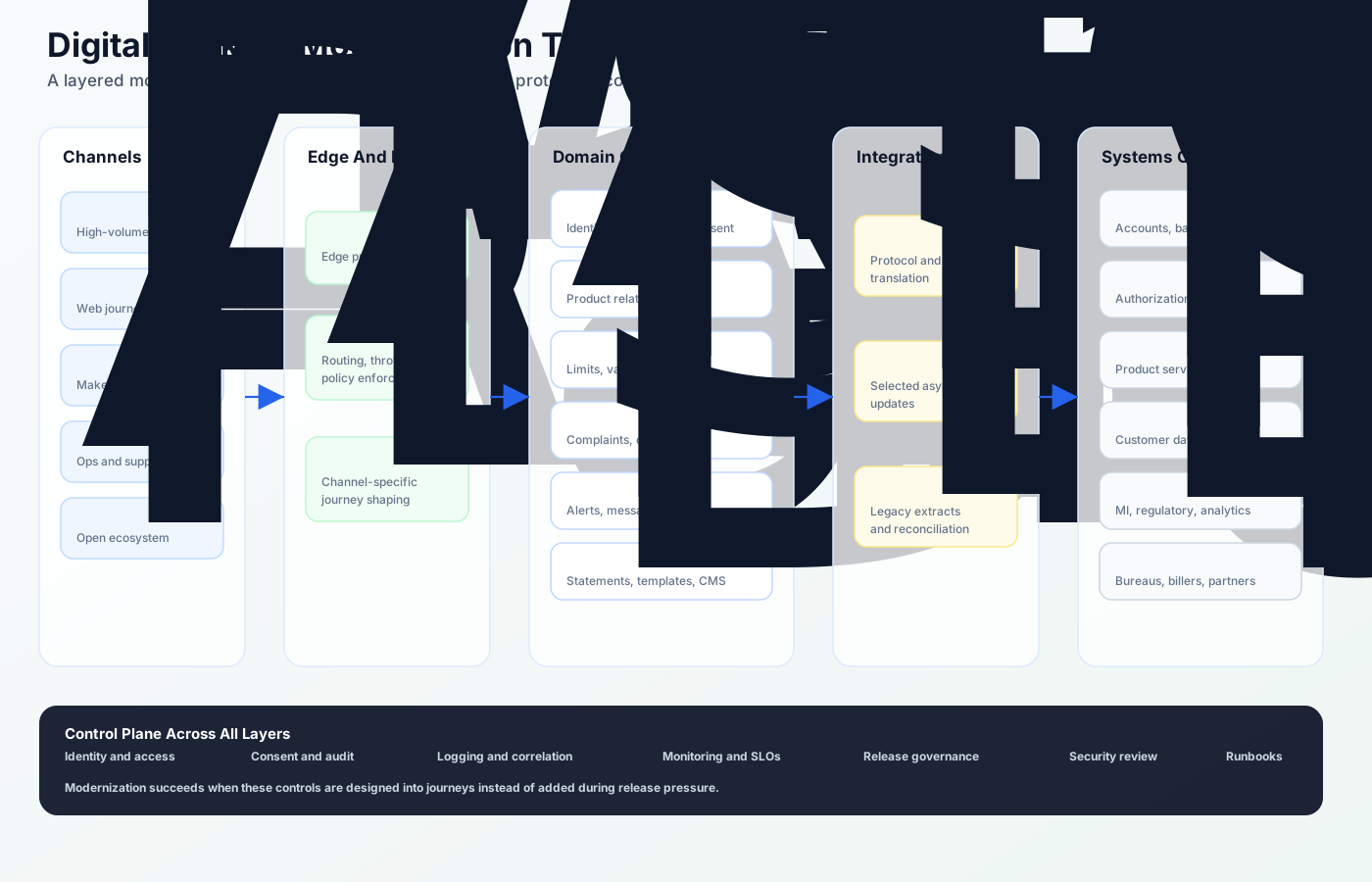
At a high level, the target state followed this model:
- Channels focus on customer experience, device capabilities, and journey presentation.
- Experience APIs and BFFs shape responses for mobile, web, business banking, and partner use cases.
- Domain services own reusable banking capabilities such as customer profile, accounts, payments, limits, service requests, notifications, documents, and consent.
- Integration layer protects core systems from channel-specific coupling.
- Core systems remain systems of record for products, balances, transactions, KYC, cards, loans, CRM, and reporting.
- Control plane provides observability, security, audit, release governance, and operational readiness.
The most important change was not introducing a new layer. It was making the responsibility of each layer explicit.
What Changed Architecturally
The modernization work was grouped into practical architecture changes.
1. Channel Responsibilities Were Clarified
Earlier, channels were doing too much. Some journeys had business rules, integration fallback logic, response shaping, and operational assumptions spread across mobile, web, and admin implementations.
The new model moved shared logic into domain services or experience APIs, depending on where the responsibility belonged.
This helped in three ways:
- Mobile and web journeys became more consistent.
- Reuse became easier because capabilities were exposed through clearer APIs.
- Defects became easier to trace because fewer layers were making hidden decisions.
2. API Contracts Became More Intentional
The API layer had to stop being a pass-through wrapper over backend systems.
We introduced stronger API contract discipline:
- Stable resource naming.
- Consistent error models.
- Correlation IDs across journeys.
- Idempotency rules for sensitive operations.
- Versioning only for meaningful contract breaks.
- Clear ownership for every API.
- Better examples in API documentation.
This reduced ambiguity during development and made cross-team reviews more concrete.
3. Integration Was Treated As A Product Capability
Integration logic was too important to be treated as plumbing.
We defined patterns for:
- Synchronous API calls.
- Asynchronous events.
- File or batch integrations where real-time integration was not available.
- Retry and compensation behavior.
- Timeouts and circuit-breaker expectations.
- Source-system error translation.
- Audit logs for regulated journeys.
This helped teams avoid reinventing integration behavior for each journey.
4. Operational Readiness Moved Earlier
Previously, operational readiness was often checked near release time. That created late surprises.
We moved readiness expectations earlier into design and delivery:
- What needs to be logged?
- Which correlation ID travels across systems?
- What should a support engineer see when a transaction fails?
- What are the known failure modes?
- Which dashboard proves the journey is healthy?
- What is the rollback or containment plan?
For critical banking journeys, these questions are part of the architecture, not an operations appendix.
Phased Execution Model
The migration was structured into phases so the organization could make progress without creating uncontrolled delivery risk.
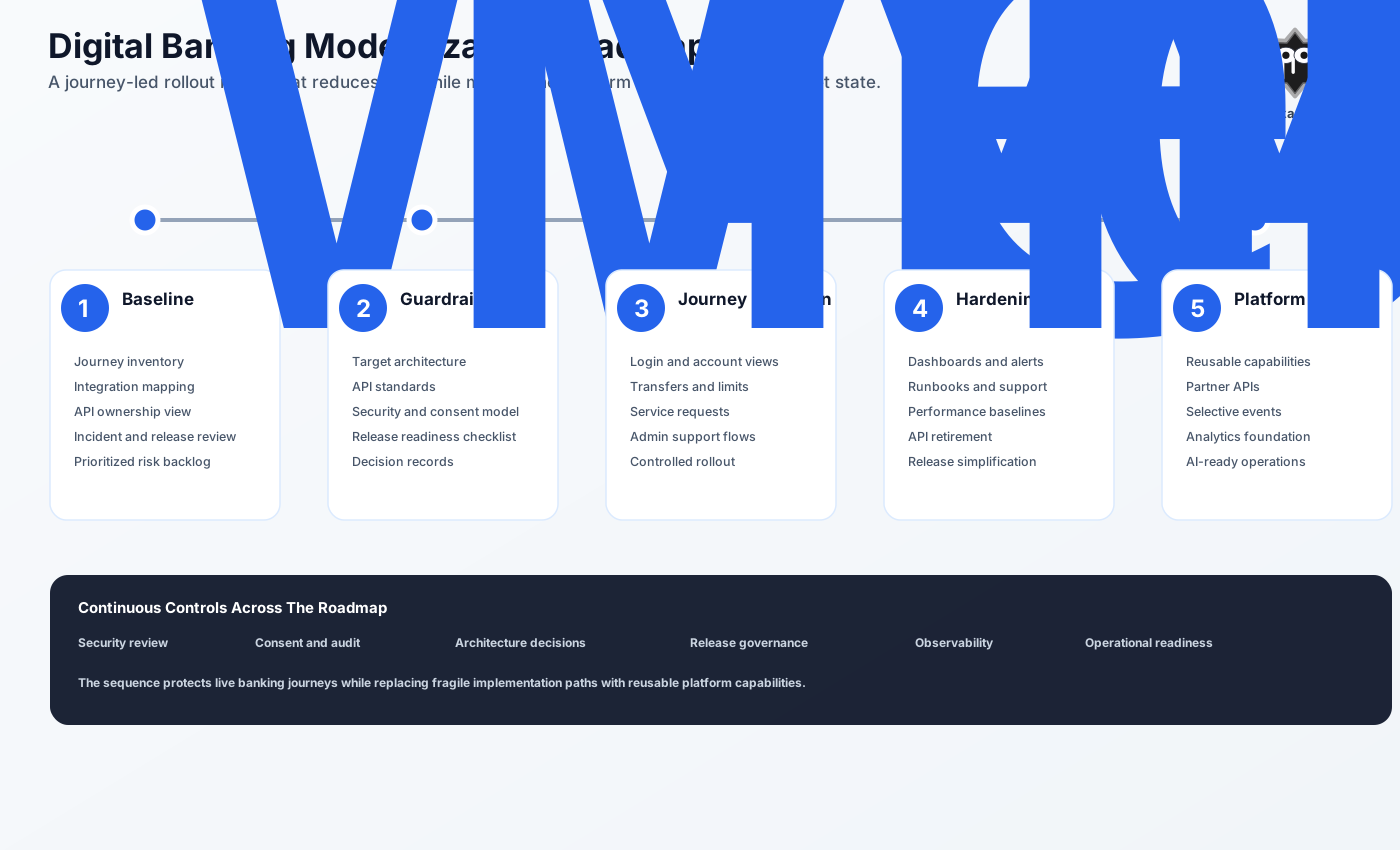
The phases were deliberately practical.
Phase 1: Current-State Baseline
The first phase created a fact base.
Activities included:
- Journey inventory.
- Integration mapping.
- API and service ownership mapping.
- Pain-point workshops with product, engineering, support, and operations teams.
- Release and incident history review.
- High-risk journey identification.
The output was a prioritized modernization backlog, not a theoretical architecture deck.
Phase 2: Target-State And Guardrails
The second phase defined the direction of travel.
Activities included:
- Target architecture definition.
- API standards and review checklist.
- Integration pattern catalog.
- Security and consent guardrails.
- Logging and observability baseline.
- Release readiness checklist.
- Decision record template.
The goal was to make design decisions repeatable across teams.
Phase 3: Journey-Based Migration
The third phase focused on moving real customer journeys.
We did not migrate by technical layer alone. We migrated by journey because that is how value and risk are experienced by customers.
Example migration candidates included:
- Login and session management.
- Account summary.
- Fund transfers.
- Beneficiary management.
- Service requests.
- Business banking approvals.
- Admin support journeys.
For each journey, the team defined the current path, target path, dependencies, fallback behavior, monitoring needs, and release plan.
Phase 4: Operational Hardening
After journeys moved, the focus shifted to hardening.
Activities included:
- Improving dashboards and alerts.
- Reducing noisy logs and missing logs.
- Clarifying support playbooks.
- Strengthening incident triage paths.
- Cleaning up obsolete integrations.
- Retiring unused APIs.
- Reducing release coordination friction.
This phase is often underestimated. A journey is not truly modernized until it is supportable in production.
Phase 5: Platform Scale
Once the core patterns were proven, the platform could support broader capability expansion:
- Faster rollout of new journeys.
- Better reuse across retail and business banking.
- Partner and ecosystem APIs.
- Event-driven updates for selected scenarios.
- Stronger data and analytics foundations.
- Better readiness for AI-assisted servicing and operations.
Modernization should create options. If it only replaces old technology with new technology, the business value remains limited.
Governance Model
The governance model had to be firm enough to improve quality and light enough to keep delivery moving.
We used four operating rhythms:
| Rhythm | Purpose | Output |
|---|---|---|
| Architecture review | Validate major design decisions before build | Approved direction, risks, open questions |
| API and integration review | Prevent inconsistent contracts and hidden coupling | Contract feedback, ownership clarity, versioning decisions |
| Delivery checkpoint | Keep modernization aligned with sprint and release plans | Dependency actions, decision closure, escalation items |
| Operational readiness review | Confirm supportability before production movement | Dashboard, runbook, rollback, monitoring, support handoff |
The reviews were not meant to create paperwork. They created shared decisions.
Delivery Workstreams
The modernization was easier to manage when it was split into workstreams with clear ownership.
| Workstream | Focus area |
|---|---|
| Channel experience | Mobile, web, business banking, admin usability, journey consistency |
| API and domain services | Reusable capabilities, contract quality, ownership boundaries |
| Integration | Core banking, cards, payments, KYC, CRM, reporting, third-party systems |
| Security and compliance | Authentication, authorization, consent, audit, policy enforcement |
| Platform engineering | CI/CD, environments, observability, release automation, operational tooling |
| Quality engineering | Test strategy, regression coverage, non-functional validation, production readiness |
| Change management | Stakeholder alignment, release planning, communication, adoption support |
This structure helped avoid a common modernization failure: everyone agrees on the target state, but nobody owns the transition details.
KPI Framework
For confidentiality reasons, I am not publishing client metrics. But the KPI framework below shows the areas that were tracked before and after transformation.
| Outcome area | Example measurement |
|---|---|
| Delivery speed | Lead time for change, release cycle time, blocked dependency count |
| Release confidence | Deployment success rate, rollback frequency, pre-release defect trends |
| Customer journey quality | Journey completion rate, drop-off points, failed transaction visibility |
| Reliability | Uptime for critical journeys, incident frequency, mean time to recovery |
| Support effectiveness | Time to identify failure source, completeness of logs, handoff quality |
| Architecture health | Duplicate API count, obsolete service count, contract review compliance |
| Governance quality | Decision closure time, exception count, unresolved risk aging |
The value of this framework is that it connects architecture choices with operational and business outcomes.
Risk Controls
The risk model was explicit because banking modernization has very little tolerance for surprises.
Important controls included:
- Journey-level migration planning so customer impact was visible.
- Feature flags and controlled rollout where journeys could be enabled gradually.
- Parallel run windows for selected capabilities where old and new paths needed comparison.
- Rollback and containment plans for critical releases.
- Audit and access reviews for journeys involving sensitive customer data.
- Performance baselines before high-volume traffic movement.
- Operational dashboards before go-live, not after go-live.
- Clear release ownership across product, engineering, testing, operations, and vendor teams.
The risk approach was not to avoid change. It was to make change observable, reversible where possible, and owned.
Lessons Learned
1. Modernization Is A Sequencing Problem
Most teams know the target architecture they want. The harder question is sequence.
What moves first? What waits? Which dependency blocks the next journey? Which old integration can safely stay for six more months? Which shortcut will become expensive if accepted now?
The roadmap matters as much as the architecture diagram.
2. APIs Define Team Boundaries
Poor API design creates poor team coordination. When contracts are unclear, teams spend time clarifying assumptions in meetings, debugging integration behavior, and negotiating exceptions.
Good API contracts reduce communication load. Teams still need to collaborate, but the collaboration becomes more focused.
3. Supportability Must Be Designed
In banking, a successful digital journey is not only one that works for the customer. It must also be supportable when something goes wrong.
Support teams need correlation IDs, meaningful errors, journey logs, runbooks, dashboards, and clear ownership. If these are missing, every incident becomes a manual investigation.
4. Governance Should Help Delivery
Governance fails when it behaves like a separate approval department.
It works better when it gives teams reusable patterns, clear decision points, and fast feedback. Architecture governance should reduce ambiguity, not add ceremony.
5. Do Not Confuse Migration With Modernization
Moving code to a new platform does not automatically modernize the business capability.
The real modernization happens when ownership becomes clearer, journeys become easier to change, incidents become easier to understand, and the platform can support new business models with less friction.
What I Would Watch Closely In Any Similar Programme
If I were reviewing another digital banking modernization roadmap, I would pay close attention to these areas:
- Is the modernization roadmap journey-led or technology-led?
- Are core APIs designed as product contracts or as system wrappers?
- Is there a clear ownership model for every customer-facing journey?
- Are security, consent, audit, and operational logging part of design reviews?
- Does the release plan protect critical banking traffic?
- Can support teams trace failures without calling five engineering teams?
- Are old APIs and integrations being retired, or only new ones being added?
- Are business leaders able to see progress through outcome metrics?
These questions reveal whether the programme is only changing technology or actually improving the operating model.
Outcome Areas
This modernization pattern improved the platform in the areas that matter most to product and engineering leadership:
- Better consistency across mobile, web, business banking, admin, and API journeys.
- Clearer ownership across channels, domain services, integrations, and operations.
- Reduced release ambiguity through stronger architecture and readiness checkpoints.
- Better production support through improved logging, correlation, and operational handoffs.
- More disciplined API evolution with fewer accidental versions and unclear contracts.
- Stronger alignment between business priorities and engineering execution.
- A foundation for future capabilities such as ecosystem APIs, analytics, and AI-assisted servicing.
Frequently Asked Questions
Q: Is this based on a real engagement?
Yes. This is an anonymized account of a real transformation programme. Details, names, and sensitive client identifiers have been changed to protect confidentiality.
Q: What size of team and platform is this relevant for?
The patterns apply to teams of 20-200+ engineers working on customer-facing banking platforms across multiple channels. Smaller teams can use a lighter version of the same approach. Larger teams need stronger operating rhythms and ownership discipline.
Q: How long does a transformation like this take?
The architecture framing and initial operating model can be established within the first 8-12 weeks. Full platform outcomes usually unfold over 12-24 months depending on scope, system complexity, vendor dependencies, team maturity, and release constraints.
Q: What should a bank do first if the platform already feels too complex?
Start with a journey and integration inventory. Do not begin by buying a tool or redrawing the architecture. First understand which journeys matter most, which systems they touch, where failures happen, and who owns each part of the flow.
Q: Can this work with legacy core banking systems?
Yes, but the architecture must be honest about legacy constraints. Not every system can become event-driven or API-first immediately. The target state should protect the core, reduce direct channel coupling, and migrate integration behavior gradually.
Q: Can you help us apply this to our specific context?
Yes. The engagement starts with a structured conversation to map current-state pain points, modernization goals, risks, and leadership priorities. Work With Me to explore the options.
Q: Do you work with banks outside India?
Yes. The patterns in this case study are applicable across markets. I have worked with teams operating in international contexts including GIFT City and Gulf-region digital finance programmes.
Related Artifacts
- Detailed reference solution: Channel Banking
- Architecture article: The Technology of Modern Banks
- API design note: APIs Are Forever
- Customer data platform article: Customer 360 Degree Solution for Banks
- Collaboration options: Work With Me
- Speaking sessions for leadership teams: Speaking
Want to review your modernization roadmap?
If your team is balancing digital banking modernization with business continuity, I can help shape a practical architecture, delivery sequence, and operating model.